
The lead that doesn't just look right – it's worth winning.
Next-Gen MQLs are leads scored and ranked by their potential value to your business, using buyer-seller fit rather than generic intent signals.
Intent data tells you that a company is consuming content, but your competitors can all see the same signal. Next-Gen MQLs go further, using your own data to predict which accounts have the strongest potential to become valuable customers.
The question is no longer “Is this account in-market?” It’s “How valuable could this lead be to us?”
Discover the Next-Gen MQL Difference




What an MQL should mean.

Broad ICP Fit
Is this account likely to buy something that looks like what you're selling?

In-Market Probability
Is this account likely to be in-market, based on category demand?

Buyer-Seller Fit
Is this account likely to buy from you – and are you set up to sell to them?

Customer Value Fit
Is this account likely to become a high-value customer in the long run?
Turning your data into higher-value leads.
Next-Gen MQLs combine your data, your commercial priorities, and our modeling to identify where there is the greatest opportunity to win.
Scored on your data
Our Buyer-Seller Fit score uses vector modeling across your own data to identify the accounts and clusters you're best positioned to win.
Prioritized by value
The Return on Sales Effort (RoSE) quadrant weighs value against velocity, helping focus your effort where the return is highest.
Delivered to sales
We deliver Next-Gen MQLs from the accounts with the strongest commercial potential, creating a pipeline worth pursuing.
Better targeting = better odds of winning.
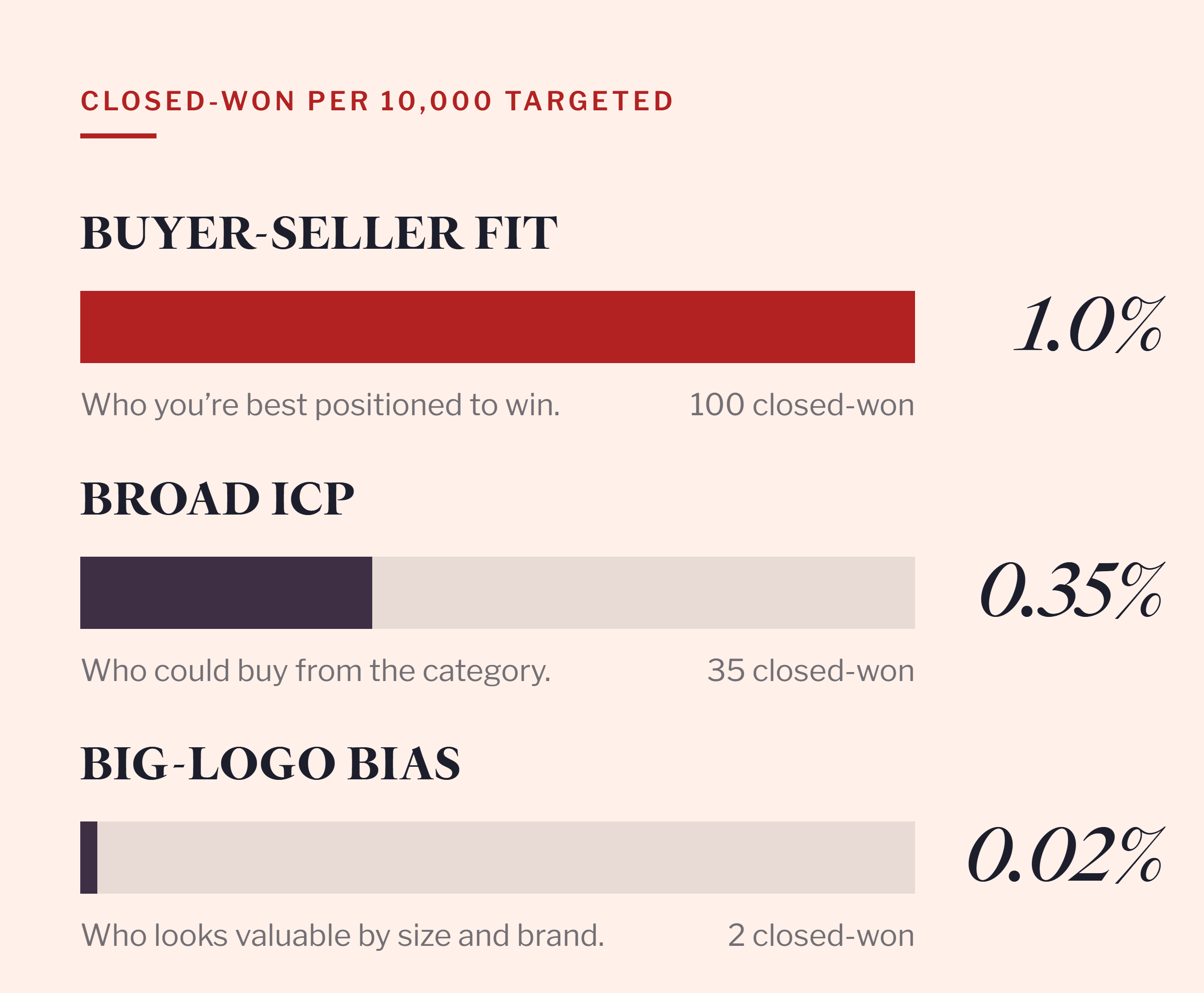
Consider the same 10,000 accounts. Each list is the same size and equally “in-market.”
Broad ICP tells you who could buy. Big-logo bias tells you who looks valuable. Buyer-seller fit tells you where you have the strongest reason to believe you can win.
Only the targeting logic changes – yet the close-won rate swings 50x.

Evidence-based modeling, not a black box.
Most traditional approaches tells you what a lead scores, without telling you why.
Next-Gen MQLs work differently. Each score draws on your commercial data – fit against your best customers, account value and comparable deal outcomes – so we can explain why the data going in produces the number coming out.
The result is a lead score you can understand, interrogate, and act on.
Questions we hear about Next-Gen MQLs.
We use human expertise to build the model, deliberately, with judgement about how your data should be read, and use automation only to execute it. You're choosing between a system with very little transparency and one that's designed by people who can show you exactly why it works. When you're about to commit budget on the output, being able to interrogate the method isn't a nice-to-have, it's the whole point.
Intent data tells you an account is consuming content on a topic, and so does every competitor's intent tool, reading the same signal about the same account. It's shared information you're all bidding against. We measure something only you have: the fit between an account and your business, learned from where you actually win. Intent tells you who's looking. Fit tells you who's worth your sales team's time.
Two things most teams aren't doing. First, if you're confident in your ICP, we'll either confirm it with hard evidence, or show you where it's quietly costing you. Either outcome is worth knowing. Second, even when your account list is right, we add what it's usually missing: prioritization and timing. Which of your good accounts is worth the most over its lifetime, and which markets are heating up right now. We don't replace your list, we sequence it. (And the usual point-based lead scoring, three points for an e-book, five for a pricing page, is easy to understand and almost always wrong, because adding up engagement isn't the same as measuring fit.)
A lookalike list is a black box: you hand a platform some names, it hands back more names, and the machinery in between is invisible. Worse, ad platforms are incentivized to pad those lists with high-traffic companies that burn your budget, which is why lookalikes deliver reach but no engagement. We do the matching openly: not "find companies like Adobe," but companies in these industries, these revenue ranges, these geographies, then we score everyone against your model and cut everything below a quality threshold. Reach you can explain, not reach you have to trust on faith.
Often, no names at all. The model learns from the shape of your deals, industry, size, geography, how they closed, not the identities behind them. We can work from a summarized, anonymized extract where every account is just a profile. We'll meet your data wherever it sits: the more you can enrich and roll up in-house, the faster you get an answer and the fewer governance questions anyone has to field. If you don't have the enriched data then we can help you get this done.
Your data trains a model that's yours, built on your history. We're happy to sign NDAs, DPAs, whatever your team needs. And because much of the work can run on anonymized, rolled-up data, for many engagements the sensitive detail never leaves your side at all.
Every CRM is messy, it's the universal starting condition, not a disqualifier. A lot of the mess washes out, because duplicate and mistyped accounts roll up into the same profile anyway. Where data is thinner or more anonymized, the model gets less precise, wider error bars, but not less valid. And we can show you those error bars: this is a method that reports its own confidence, not one that hands you a falsely precise number and hopes you don't ask.
Yes, the model is built on your data, so that's the first step; there's no generic version to hand you. But "first step" can be fast: if you can give us a clean, rolled-up extract, we can be close to an answer quickly. The best way to see it is small and concrete, a proof-of-concept on a slice of your accounts, where we compare what the model surfaces against the list you already trust.
Find more of the accounts worth winning.
